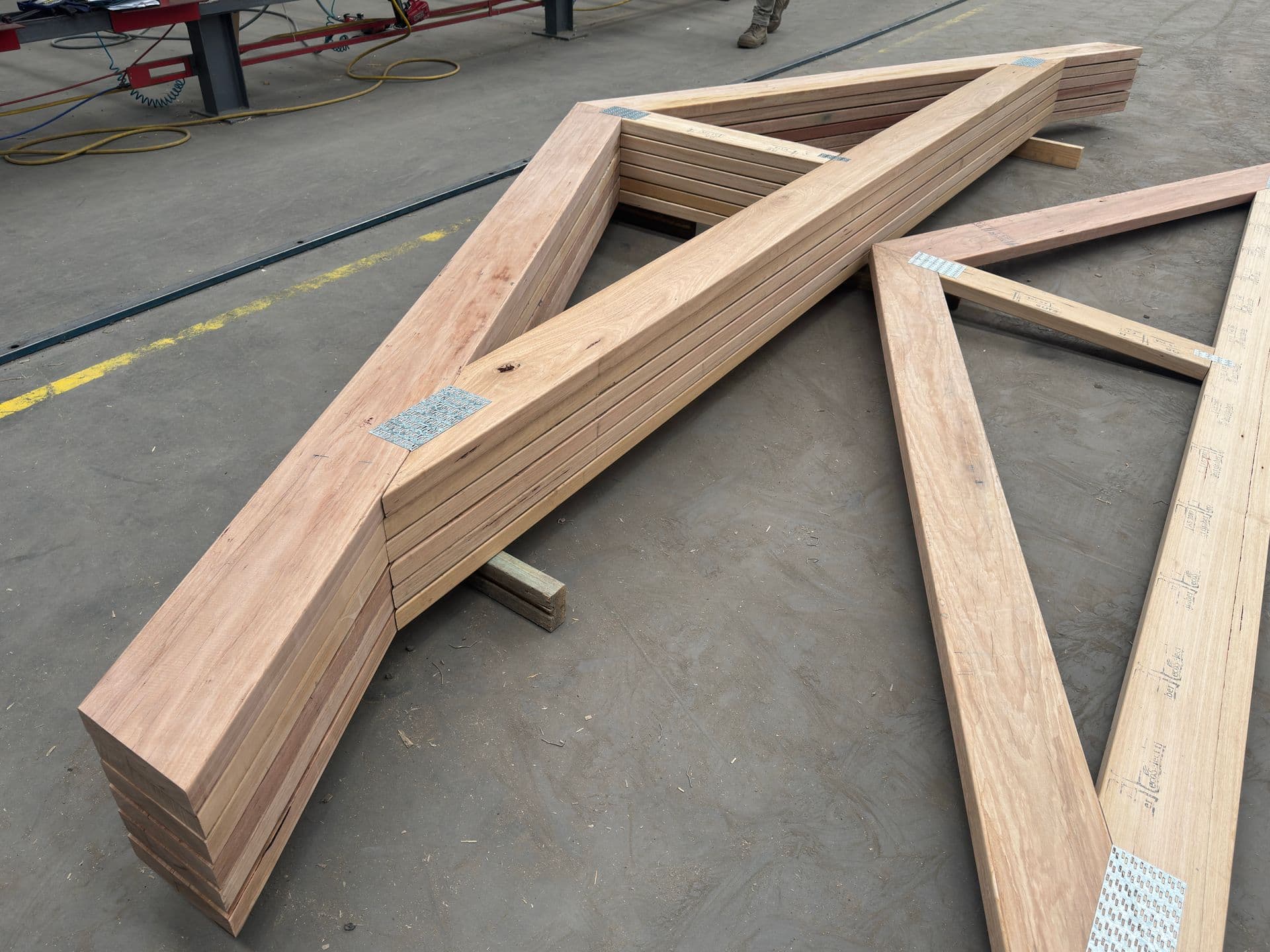
If you are pricing a new roof in Melbourne, the first fork in the road is how it gets framed: prefabricated roof trusses built off-site, or rafters cut and assembled on the roof. Both end up holding your tiles or sheet up. The difference is in cost, programme and how much labour you carry on site.
Here is the honest comparison, from a manufacturing facility that has been building trusses in Coolaroo since 2006.
What is a roof truss?
A truss is a triangulated frame, engineered as a single unit and fixed together with steel connector plates. The triangle is the point: it spreads load across the chords and webs so the whole frame carries weight without internal support walls. We press our plates with Multinail connectors and cut the timber to the engineer's design on a computer-controlled saw, so every truss in a run is identical.
Trusses arrive on a truck, get craned up, and get fixed in sequence. The shape is already decided before they reach your site.
What is a cut (rafter) roof?
A cut roof is framed the traditional way: a carpenter measures, cuts and fixes each rafter, ridge, hanging beam and strut in place on top of the build. Nothing is prefabricated. It is a skilled, time-honoured method, and for some complex or one-off rooflines it is still the right call.
The trade-off is time and labour. Everything happens at height, in the weather, on your programme.
Cost: where the money actually goes
People assume a cut roof is cheaper because there is no factory in the middle. On material alone, sometimes. But the real number is installed cost, and that is where trusses usually win:
- ✓Labour on site drops sharply. A truss roof on a standard home goes up in a day or two with a small crew. A cut roof of the same size can tie up skilled carpenters for the better part of a week.
- ✓Waste is lower. We cut to plan at our facility, so off-cuts stay in Coolaroo, not in your skip.
- ✓Programme is shorter, and time is money on a build — every extra day at frame stage delays lock-up, trades and your finance.
For most residential roofs in Victoria, prefabricated trusses come in cheaper once you count the labour you are not paying for.
Speed and weather
This is the clearest difference. Trusses are built undercover while your slab and walls are going up, so the roof is ready before you need it. Once the wall frames are standing, a truss roof can be craned and fixed fast, and you are chasing weather-tight in days, not weeks.
A cut roof is built entirely on site and entirely exposed. Rain on a half-cut roof is a real problem.
Spans and design freedom
Engineered trusses handle long clear spans without internal load-bearing walls, which is why open-plan living rooms work. The design is set by an engineer to AS 1684 and your wind classification, so the span, pitch and loadings are signed off before a single piece of timber is cut.
Cut roofs can do clever, irregular geometry that is awkward to prefabricate. If you have a genuinely complex or heritage roofline, talk to your designer about a hybrid: trusses over the simple spans, a cut section where it counts.
So which should you choose?
| Prefabricated trusses | Cut rafters | |
|---|---|---|
| Installed cost (typical home) | Lower | Higher |
| Time on site | 1–2 days | Up to a week |
| Weather exposure | Minimal | High |
| Clear spans | Excellent | Limited |
| Complex one-off geometry | Good | Better |
For the overwhelming majority of new homes, extensions and sheds in Melbourne, prefabricated trusses are faster, cheaper installed, and more predictable. A cut roof earns its place on the genuinely complex jobs.
If you are not sure which way your roof should go, send us your plans. We will tell you straight what suits the job — see our timber roof trusses and wall frames, or get a quote and we will come back to you.